Ahead of His Time: Mudashiru Ayeni and the Machine Nigeria Wasn’t Ready For

Updated: Sep 15

Originally written for "THE RECORD" | AUGUST 2026
Nigerians have been creating and innovating for decades, without recognition.
Long before AI and automation became buzzwords, a young Nigerian, Mudashiru Ayeni, built a battery-powered robot office assistant in the early 1970s. His story has resurfaced thanks to an archival account revived by Archivi.ng in February 2026.
Ayeni believed in his invention and sought official recognition for it.
He tried to present the device to the Head of State, General Yakubu Gowon. Instead of support, his school authorities responded by sending him for a psychiatric evaluation. He was reportedly questioned repeatedly before being declared mentally sound.
The moment passed years ago. But thanks to the resurfaced archive, we get to hear the story not of an industrialist or a university-backed engineer, but of a young man growing up under the regime of General Yakubu Gowon (1966–1975), a period defined by civil war, its aftermath and a country scrambling to rebuild its national institutions. Government focus was on stability, administration and reconstruction, not on encouraging experimental technology from unknown individuals. Ayeni was simply ahead of his time.
According to the revived records, he was a 20-year-old student with a strong interest in electronics. He spent his time dismantling radios and thinking about machines that could take over routine, manual work. In an environment where office work depended heavily on human intermediaries, clerks and messengers, a simple automated office assistant would have seemed unusual.
What did the machine do?
The accounts describe the device as the Mudagraph, also referred to as the Receptograph, a machine intended to serve as a simple office receptionist. Its function was simple: a caller or visitor could press a button, and it would tell them whether the boss was available, busy or away from the office. It was battery-powered and relied on preset responses rather than any complex processing.
In effect, Ayeni built what we would recognise today as an automated receptionist, the kind of system that now greets callers on every corporate phone line. Only he did it five decades ago. Later retellings suggest he eventually reached Aminu Kano, a prominent figure in the federal government, who is said to have listened and offered encouragement. Some businessmen reportedly expressed interest.
After that, the trail goes cold: no patents, no company, no known follow-up.
Only the fragments are preserved in the archive.
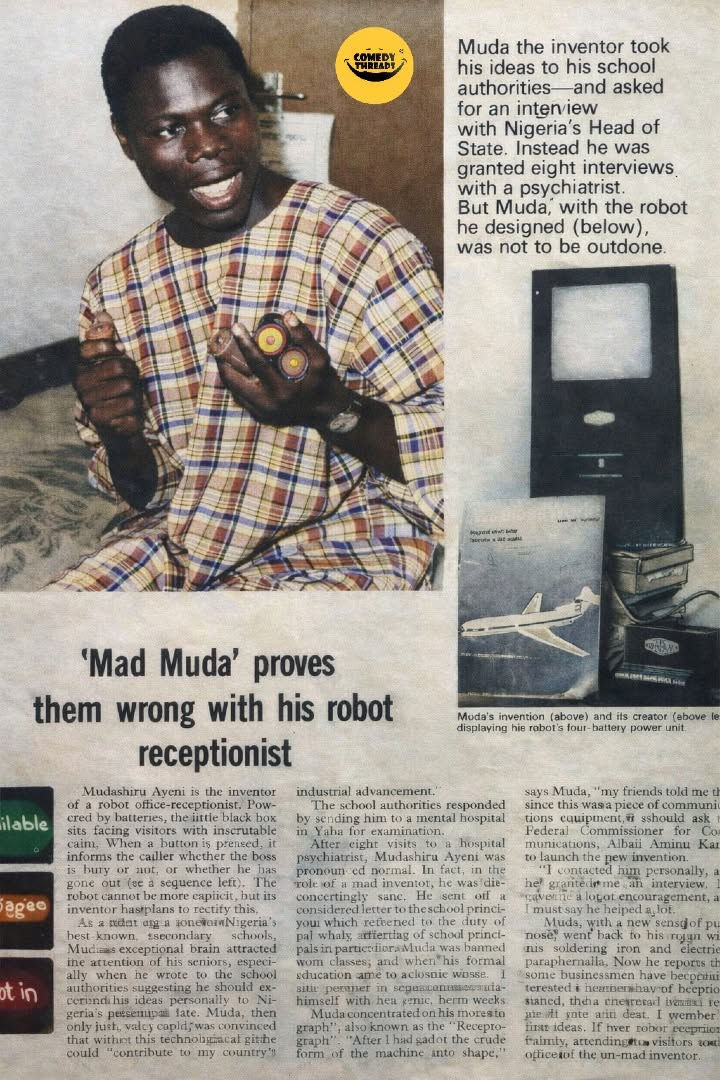
Even after being declared entirely sane, Ayeni faced severe institutional pushback. He wrote an ambitious letter to his school principal detailing the vital role young Africans needed to play in developing the continent's technology.
In response, the school banned him from classes and forced him to leave entirely.
He did receive minor encouragement and an interview from Alhaji Aminu Kano, the Federal Commissioner for Communications, and a few local businessmen expressed tentative interest. However, without structural funding, institutional backing, or an ecosystem to support technology, his invention never scaled.
Source: Historical Nigeria (April 2026), drawing on Archivi.ng, Technext and Legit.ng.



Comments